QRefAI

Building agentic AI that survives production.

Most AI apps don't fail because the model is weak. They fail because the system around it was never designed — just assembled.

This website treats agentic AI as a systems design problem: state, data flow, failure handling, and control. Sharpen those, and you can push any model to its limit.

Start reading ↓

Four pillars, one underlying discipline

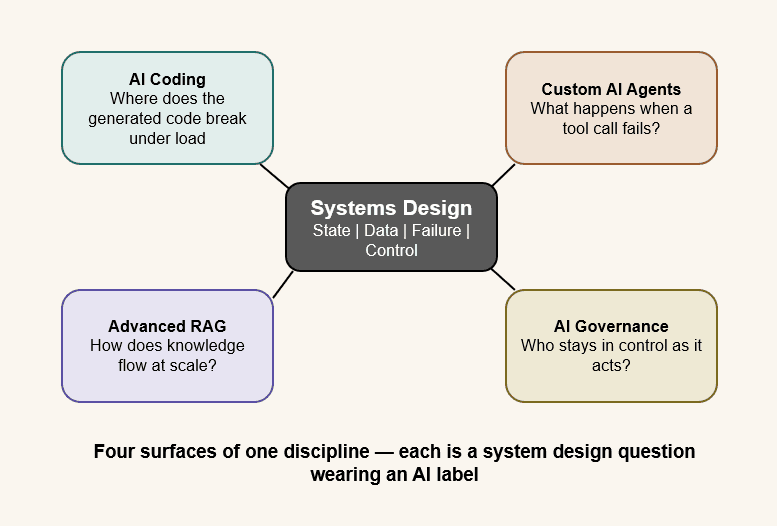
Coding, retrieval, agents, and governance look like four separate skills. They're really four views of the same system design questions — how data moves, where state lives, what happens when a component fails, and who stays in control. Engineers who see that connection build AI that survives contact with real traffic. Those who treat each pillar as an isolated trick ship demos that wobble.

The model is a component. The system is the product.

Diagram showing Systems Design at the centre connected to four pillars: AI Coding (where does generated code break under load), Custom AI Agents (what happens when a tool call fails), Advanced RAG (how does knowledge flow at scale), and AI Governance (who stays in control as it acts)

What you'll find in each pillar

AI Coding

The system design question: where does generated code break under real conditions?

  • Designing review and test boundaries so AI-written code fails loudly, not silently
  • Treating the model as an unreliable component — interfaces, contracts, fallbacks
  • Workflows that scale past one developer and one file
Advanced RAG

The system design question: how does knowledge get in, and how does it hold up at scale?

  • Retrieval as a data pipeline — ingestion, freshness, indexing, eviction
  • Why naive RAG degrades past the demo set, and the architectural fixes
  • Cost vs. accuracy as a design trade-off, not an afterthought

Custom AI Agents

The system design question: what happens between the steps — when a tool call fails, stalls, or loops?

  • State machines, retries, and idempotency for non-deterministic actors
  • Containing latency, runaway cost, and partial failure
  • Observability: tracing what an agent actually did

AI Governance

The system design question: who stays in control as the system gains autonomy?

  • Guardrails and authority limits as architectural components
  • Auditability and evaluation designed in, not bolted on
  • How control requirements shape the system before code is written

This site is about judgment, not recipes

The hard part of applied AI was never the prompt. It's the system around the model — and that's a discipline you can sharpen.

We treat AI as a systems problem.

Every topic is reduced to its underlying questions: where state lives, how data flows, what fails, and who's in control. Master those and any model becomes a tool you can push to its limit.

Concepts before tools.

Frameworks change every quarter; the design questions don't. We build the mental models that survive the next library release.

Built from real production behavior.

The lessons come from what systems do under load — latency, cost, failure, drift — not from happy-path tutorials.

For engineers who want depth.

No "what is an agent?" hand-holding. We assume you can code and want to think more rigorously about the systems you're building.

Custom AI Agents

The Production Envelope

Why do agent demos fail to become products — and what does the gap actually consist of?

8 min · Updated June 2026

Who this is for

Written for engineers who already ship and now want to ship AI that holds up. If you can build the app but sense that reliability, cost, and control come down to design decisions you haven't fully reasoned through, this is for you. The goal isn't to teach you AI — it's to sharpen the system design instincts that let you use AI to its fullest.

Concepts outlast tools

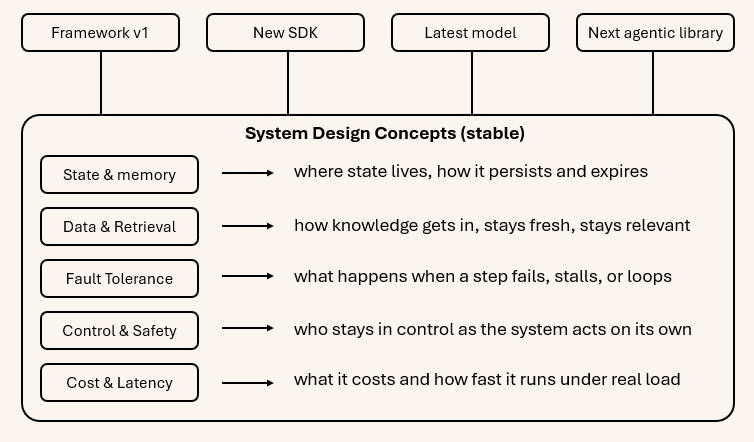
Frameworks, SDKs, and models turn over every few months — the agent library everyone swears by today will be deprecated copy in a year, and the model you built around will be two versions behind by the next quarter. What doesn't churn is the reasoning underneath.

Diagram illustrating that the underlying system design concepts — state, data flow, failure handling, and control — outlast any specific AI framework, SDK, or model