Part 7 — Recommended stack
If I’m building a production vertical agent in Python today, what should I actually use?
5 min · Updated June 2026
This is a starting point you will adapt, not gospel. It is a coherent, genuinely cloud-neutral set that will run unchanged across AWS, GCP, Azure, or on-prem.
What is the recommended stack?
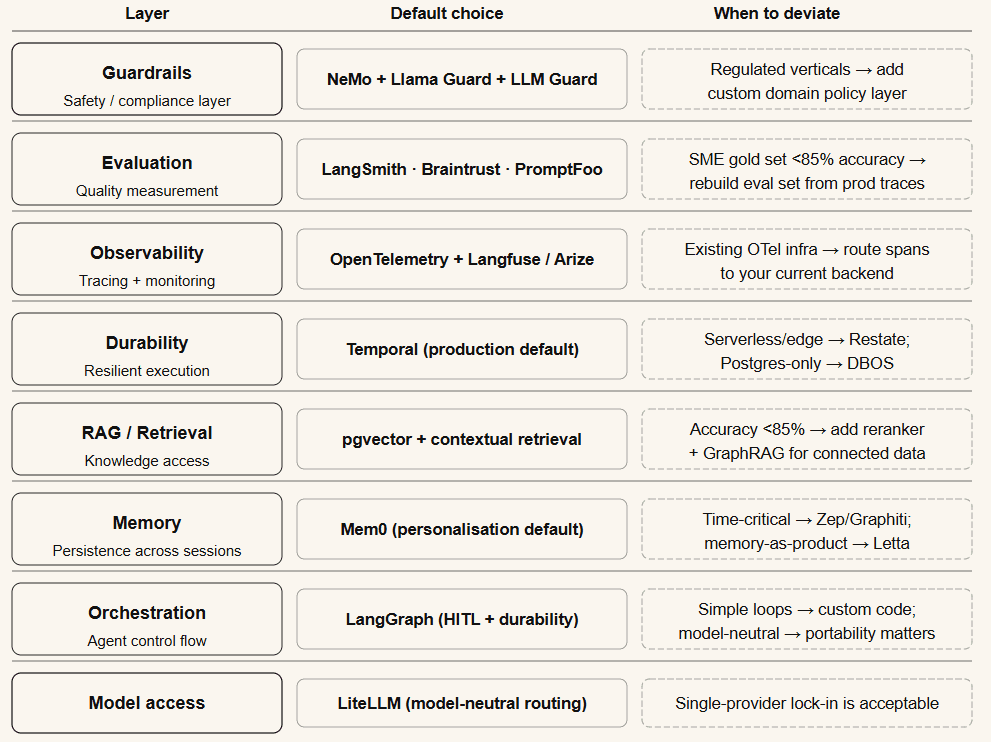
| Concern | Default choice | When to deviate |
|---|---|---|
| Orchestration | LangGraph — stateful, durable, HITL-native; the most-deployed in regulated industries | Pydantic AI if you value type-safety and a clean DX over orchestration breadth |
| Model access | LiteLLM in front, so providers are swappable | Direct provider SDK only if you have committed to one cloud |
| Tools | MCP for shared/external systems, native functions for internal ones; gateway in front | — |
| Tool efficiency | Programmatic tool calling / Code Mode once past ~20 tools | — |
| Short-term memory | LangGraph checkpointer (PostgresSaver) | — |
| Long-term memory | Mem0 for personalisation, or Zep/Graphiti for temporal reasoning | Letta if memory autonomy is the product |
| Vector store | pgvector if you already run Postgres; else Qdrant | Weaviate for native hybrid; Milvus at billion-scale; LanceDB for multi-modal |
| RAG | LlamaIndex (retrieval) + LangGraph (orchestration) | Haystack when you need explicit, auditable pipelines |
| Durability | Temporal for production | Restate for edge/serverless; DBOS for Postgres-only with no new infra |
| Observability | Langfuse or Arize Phoenix, instrumented via OpenLLMetry | Laminar for deep agent-run debugging |
| Evaluation | Ragas (RAG) + DeepEval (CI gates) + a domain gold set | Promptfoo for red-teaming |
| Guardrails | NeMo Guardrails + Llama Guard + Llama Prompt Guard + Guardrails AI | Add LLM Guard for heavy PII and secrets needs |
What is a sane rollout sequence?
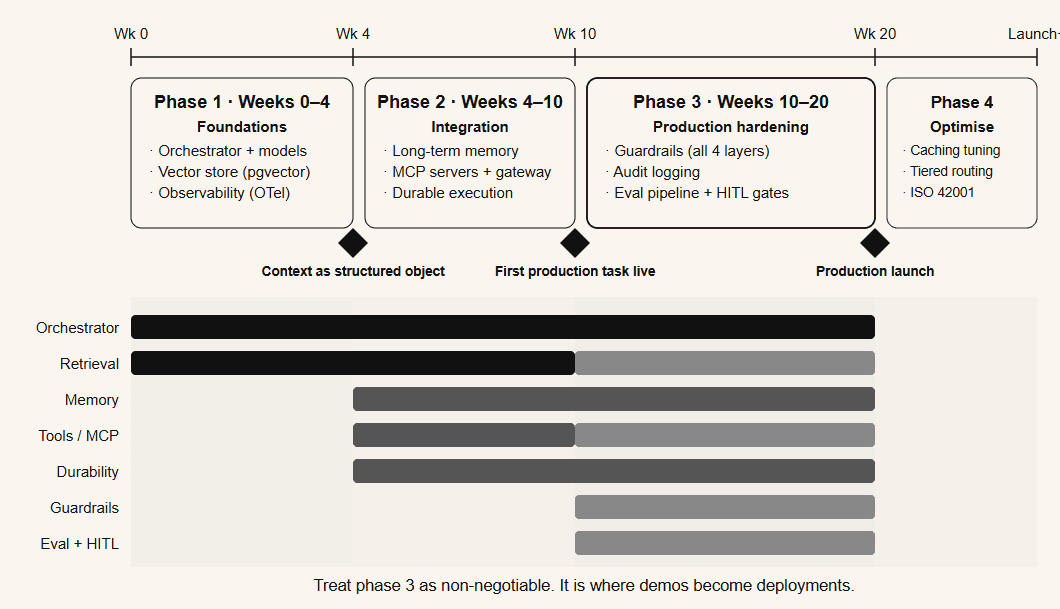
Weeks 0–4
Build the spine
Orchestrator, swappable models, a vector store, and observability from day one. Define context as a structured object assembled at the model-call boundary, never as free-form string concatenation. That single discipline prevents most context-rot pain later.
Weeks 4–10
Memory, tools, durability
Add the long-term memory layer, expose internal systems as MCP servers behind a gateway, adopt programmatic tool calling as the tool count grows, and put durable execution under anything long-running.
Weeks 10–20
Harden for the vertical
Layer the guardrails, build the audit logging to a real compliance standard, stand up the eval pipeline with SME-built gold sets, and bake HITL gates into the graph at every consequential action.
Post-launch
Scale and govern
Tune prompt caching against real hit-rate logs, move to tiered model routing for cost, adopt signed agent-identity standards (A2A) when crossing organisational boundaries, and formalise governance under ISO 42001 and the NIST AI RMF.
What four conditions should change my stack?
Trigger 1
MCP CVE pace
CVEs outpacing your patch cadence → move to a gateway/portal model immediately.
Trigger 2
Token cost spike
Multi-agent cost exceeding ~10× single-agent baseline → collapse to summary-returning sub-agents.
Trigger 3
Retrieval accuracy
Retrieval accuracy under ~85% → add reranking and contextual retrieval; consider GraphRAG if relational.
Trigger 4
HITL drift
HITL rate falling while escalations rise → rebuild your eval set from real production traces.