Part 7 — The common harness: architecture and build plan
What does the harness repo look like, and what do I build first?
8 min · Updated June 2026
You’ve read the whole map. Now you need to build something. This section gives you the actual repo structure, the full cross-vendor mapping table, the asset checklist organized by phase, and a direct answer to the question every platform engineer eventually asks: if I only have time for ten things, what are they?
The complete harness bundle — skeleton repo, mapping sheets, checklist, quick-start, and scorecard in one download. Mid-2026 snapshot — copy and edit, don't run as-is.
7.1 — What does the common harness repo actually look like?
One platform repo, vendor-neutral sources plus per-vendor compiled outputs:
acme/dev-platform/
├── AGENTS.md                       # Canonical cross-vendor context
├── CLAUDE.md                       # @AGENTS.md + Claude-specific overrides
├── .claude-plugin/marketplace.json # Claude marketplace manifest
├── .github/
│   ├── copilot-instructions.md
│   ├── agents/                     # Copilot custom agents (.agent.md)
│   ├── instructions/               # Path-scoped (applyTo)
│   ├── chatmodes/                  # Custom chat modes
│   ├── prompts/                    # Reusable prompt files
│   └── workflows/                  # GitHub Agentic Workflows (*.md)
├── agents/                         # Vendor-neutral agent source
├── skills/                         # SKILL.md folders (cross-platform)
├── hooks/                          # Hook scripts + manifests
├── mcp-servers/                    # MCP server manifests (the allowlist)
├── plugins/                        # Claude-side plugin packages
├── policies/
│   ├── claude/
│   │   ├── managed-settings.json
│   │   └── managed-settings.d/     # Team-owned policy fragments
│   └── github/ai-controls.md
├── templates/                      # Per-repo bootstrap templates
└── scripts/                        # bootstrap, compile, publish
The rule: author once in the vendor-neutral folders (skills/, agents/, mcp-servers/, hooks/), and let scripts/ compile and publish to both the .claude-plugin/ and .github/ targets.
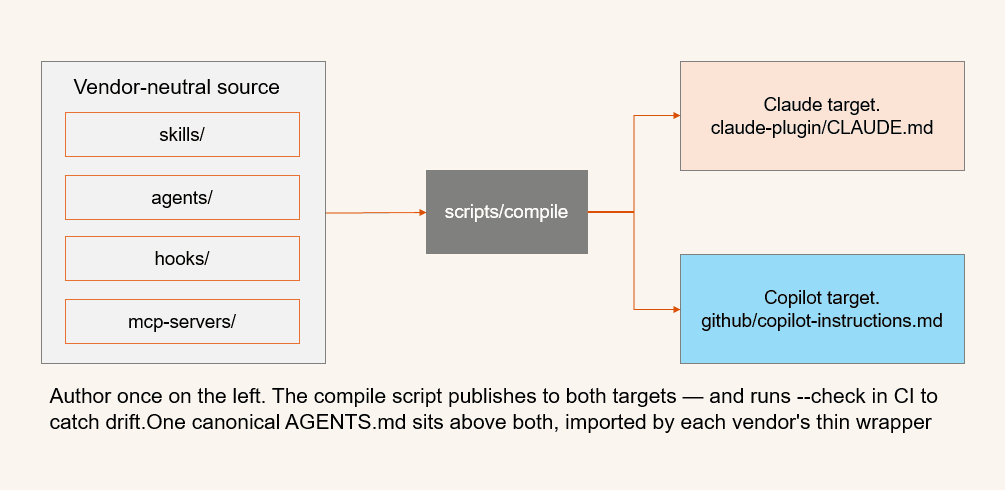
Complete platform repo skeleton with every folder from the 7.1 tree. scripts/compile.sh compiles vendor-neutral sources into both Claude and Copilot targets and includes a --check drift-gate mode for CI. Fill the placeholders using the Parts 2–5 templates.
7.2 — Give me the full Claude Code–to–Copilot mapping so I know what compiles to what.
| Concept | Claude Code | GitHub Copilot | Harness approach |
|---|---|---|---|
| Project memory | CLAUDE.md (hierarchical) | copilot-instructions.md + AGENTS.md | One canonical AGENTS.md; thin per-vendor wrappers |
| Path-scoped rules | Subdirectory CLAUDE.md | *.instructions.md with applyTo | Folder-scoped on Claude; applyTo on Copilot |
| Custom agents | .claude/agents/*.md | .github/agents/*.agent.md | Shared prompt body, two frontmatter wrappers |
| Skills | .claude/skills/<name>/SKILL.md | .github/skills/<name>/SKILL.md | One source, distributed unchanged (same standard) |
| Slash commands / prompts | .claude/commands/*.md | .github/prompts/*.prompt.md | Neutral body in skills; slash wrappers per surface |
| Chat modes | Output styles / subagent persona | *.chatmode.md | Copilot-specific UX layer, mapped from agents/ |
| Lifecycle hooks | 21 events, 4 handlers | Agent hooks + Actions + gh-aw | Claude hooks = inner loop; gh-aw = outer loop |
| External tools | MCP via claude mcp add | MCP + built-in GitHub MCP | One MCP manifest set for both |
| Plugin distribution | Plugin marketplace | Org marketplace from private repo | Two manifests, CI compiles both |
| Enterprise policy | managed-settings.json + MDM | Enterprise AI Controls + rulesets | Both run together; intent in policies/ |
| Sandboxing | /sandbox (Seatbelt/bubblewrap) | Actions runners + AWF + MCP gateway | Claude sandbox locally; AWF for automation |
| Audit | OpenTelemetry + Compliance API | Enterprise audit log streaming | Both into one SIEM, correlated on identity |
| Code review | Reviewer subagent + PostToolUse hook | Copilot code review + Autofix | Same code-review skill feeds both |
7.3 — What's the full asset checklist — what do I actually have to build?
Phase 0 — Foundations
- [ ]Cloud backend for Claude inference chosen, model IDs pinned
- [ ]GitHub Enterprise + Copilot Enterprise, AI Controls on
- [ ]
acme/dev-platformrepo created - [ ]SIEM endpoint ready for OTLP + GitHub audit-log streaming
- [ ]MDM working for managed-settings distribution
Phase 1 — Context
- [ ]Canonical
AGENTS.md(≤200 lines) - [ ]
CLAUDE.mdthat@AGENTS.md-imports it - [ ]
.github/copilot-instructions.md(dense first 4,000 chars) - [ ]Per-team
*.instructions.mdwithapplyToglobs - [ ]Org-level Copilot custom instructions
Phase 2 — Capabilities
- [ ]Skills:
code-review,secure-coding-checklist,db-migration,regulatory-logging,pii-handling,incident-runbook, plus per-domain - [ ]Custom agents:
code-reviewer,security-scout,pm-spec,architect-review,implementer-tester,docs-writer - [ ]MCP allowlist: code-intel, Jira, Confluence, Datadog/Sentry, API gateway
- [ ]AST/graph code-intel MCP server indexed across the polyrepo (nightly, in VPC)
- [ ]Claude Code LSP plugins enabled per primary language
Phase 3 — Control
- [ ]Claude hook bundle:
PreToolUseBash firewall + protected-paths gate;PostToolUselint/typecheck;SessionStartcontext injection; HTTP audit hooks - [ ]Agentic Workflows compiled
--strict: triage, security-guard, daily-status, docs-sync, agents-md-maintainer - [ ]Repository rulesets: required PR review, auto Copilot review, required status checks
- [ ]Branch protection on
mainfor all repos (template-enforced)
Phase 4 — Governance
- [ ]
managed-settings.json+managed-settings.d/fragments - [ ]MDM deployment (Jamf/Kandji, Intune/GPO, Linux pkg)
- [ ]GitHub AI Controls: session monitoring, MCP registry URL, audit streaming
- [ ]OpenTelemetry collector + SIEM dashboards
- [ ]Scheduled Compliance API pull into the warehouse
- [ ]Spend caps + per-team cost dashboards
- [ ]AI-agent incident-response runbook
Phase 5 — Distribution
- [ ]
.claude-plugin/marketplace.jsonpublished; each plugin hasplugin.json - [ ]GitHub org Copilot marketplace synced from the platform repo
- [ ]Group-level per-plugin overrides
- [ ]Repository templates bootstrapping
.github/+AGENTS.md+CLAUDE.md - [ ]
bootstrap-repo.shfor existing repos - [ ]Pilot → team → org rollout
Phase 6 — Continuous improvement
- [ ]Quarterly skill-usage review (prune unused, split over-large)
- [ ]Monthly audit-log anomaly review; tighten denies on stable signals
- [ ]Weekly Agentic Workflow token-cost review
- [ ]Track outcomes by cycle time, time-to-productive-contribution, incident resolution — not lines of code
Phases 0–6 build checklist with exit criteria per phase. Notion-importable. This governs what you build; the rollout scorecard (below) governs how you deploy it.
7.4 — If I only have time for ten things this quarter, what are they?
- 1.
AGENTS.mdat the platform repo root, imported byCLAUDE.mdandcopilot-instructions.md. - 2.Claude
managed-settings.json— MCP allowlist, model pinning, secret denies,strictKnownMarketplaces. - 3.One AST/graph code-intel MCP server in your VPC, indexed across the top ~20 repos.
- 4.A
code-reviewskill, consumed by both thecode-reviewersubagent and Copilot code review. - 5.A
PreToolUseBash-firewall hook, shipped into every repo via template. - 6.A
PostToolUseformat/lint hook, likewise. - 7.An HTTP audit hook → internal endpoint → SIEM.
- 8.A GitHub repository ruleset template: required PR review, auto Copilot review, required status checks.
- 9.A
security-guard.mdGitHub Agentic Workflow. - 10.The OpenTelemetry pipeline for Claude Code, with dashboards on
claude_code.tool_decisionandclaude_code.mcp_server_connection.
These ten give you a functional harness — context, control, and audit — before you go broad.
The ten highest-leverage items as a one-page printable sprint board, colour-coded by harness layer. Pin it up; work top to bottom.
7.5 — What's a sane rollout sequence, and how do I know when to advance?
Four phases, each with an explicit gate. The gate is a measured decision, not a calendar event.
Stand up the repo, the canonical AGENTS.md, the first five skills, one AST/graph MCP server, and the managed-settings policy.
Gate: three internal pilot users can run both tools end to end with the harness installed.
5–10 developers, one team, in audit mode — permissive allow rules, an HTTP hook logging everything, OTel live.
Gate: under 5% of sessions blocked unexpectedly; no OTel data gaps; audit endpoint uptime ≥99.5%.
20–50 developers. Tighten denies from Phase B data; add gh-aw workflows; turn on auto Copilot review.
Gate: cycle time stable or improving; no high-severity AI incidents; pilot teams self-report >25% gain; cost trending toward budget.
Push managed settings to the fleet; lock strictKnownMarketplaces.
Gate: mature audit dashboards; AI-driven incidents triaged like human-driven ones.
Phases A–D gate-criteria scorecard with measurable thresholds and a Status dropdown. Advance a phase only when its gates are green.